Publications Federated Routing
Federate the Router: Learning Language Model Routers with Sparse and Decentralized Evaluations
1Carnegie Mellon University† Equal contribution
Training routers from decentralized evaluation data
Language models vary substantially in capability and cost, and no single model is optimal for every query. A query router exploits this by selecting, per query, the model that best balances response quality and inference cost. Routers are learned from query-model evaluation data: records specifying the model selected for a query, the quality of its response, and the resulting cost.
Most router designs assume centralized access to these data. In practice, however, evaluating a broad query set against every model in the pool is expensive, and this cost recurs whenever the pool changes—an increasingly frequent event. Public benchmarks are an imperfect substitute because operational query distributions are long-tailed and shift over time. Most importantly, the evaluations most representative of deployment are often not public: they are produced by end users and organizations running LLM-backed products, and consist of customer conversations, internal code and proprietary prompts that privacy or regulatory constraints may prevent from being pooled into a central dataset.
This work studies whether a router can be trained without centralizing these data. The framework is federated: each client trains on its own records, a server aggregates only model parameters or summary statistics, and every client receives a shared routing policy learned from aggregated cross-client information.
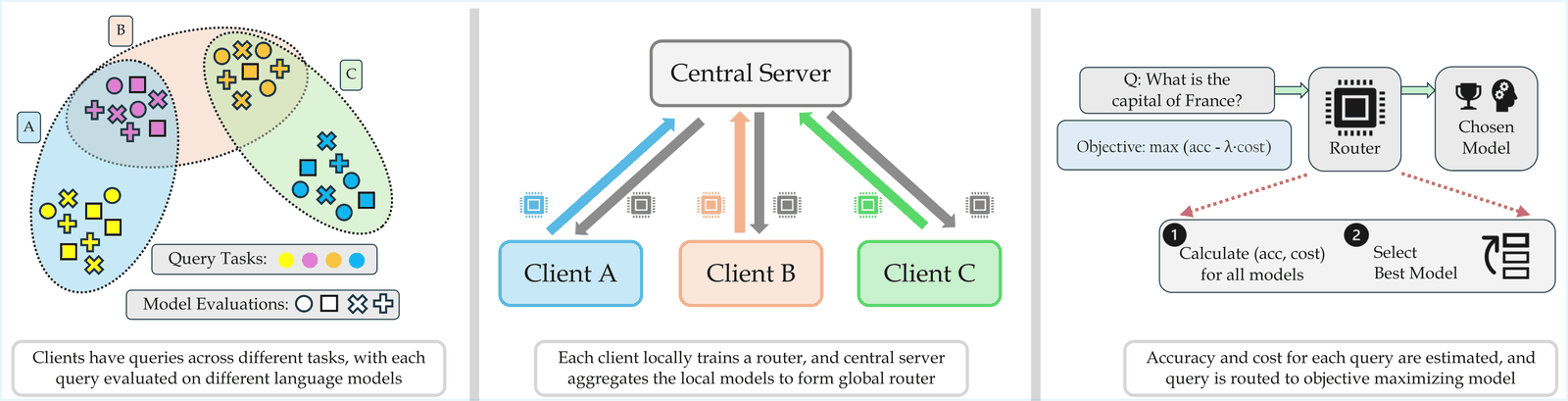
Challenges of client-local evaluation data
Three interacting properties of client-held data make local router training challenging.
The first is a skewed query mix. Clients are partitioned by task, so each sees the prompt space in different proportions. At the moderate skew used in the main experiments, this primarily changes distributional mass rather than support: a typical client’s queries still occupy 35 to 63 per cent of the populated embedding space. The composition nevertheless differs substantially. HellaSwag accounts for 68% of one client’s queries and 3% of another’s; MMLU ranges from 18% to 63%. Pushed to the extreme setting studied later, the client distributions become nearly disjoint, producing substantial differences in support.
The second is sparse evaluation. Evaluating each query against all models requires one generation per model, so practical logs often record the outcome only for the model that was actually called. Every training record is therefore one cell of a large query-by-model table, and the rest of the row is missing.
The third is imbalanced model coverage. Model selection follows a client-specific logging distribution, so observed model frequencies are highly non-uniform and differ across clients. A client may hold thousands of evaluations for one model and none at all for another, leaving local estimates for unobserved models poorly constrained.
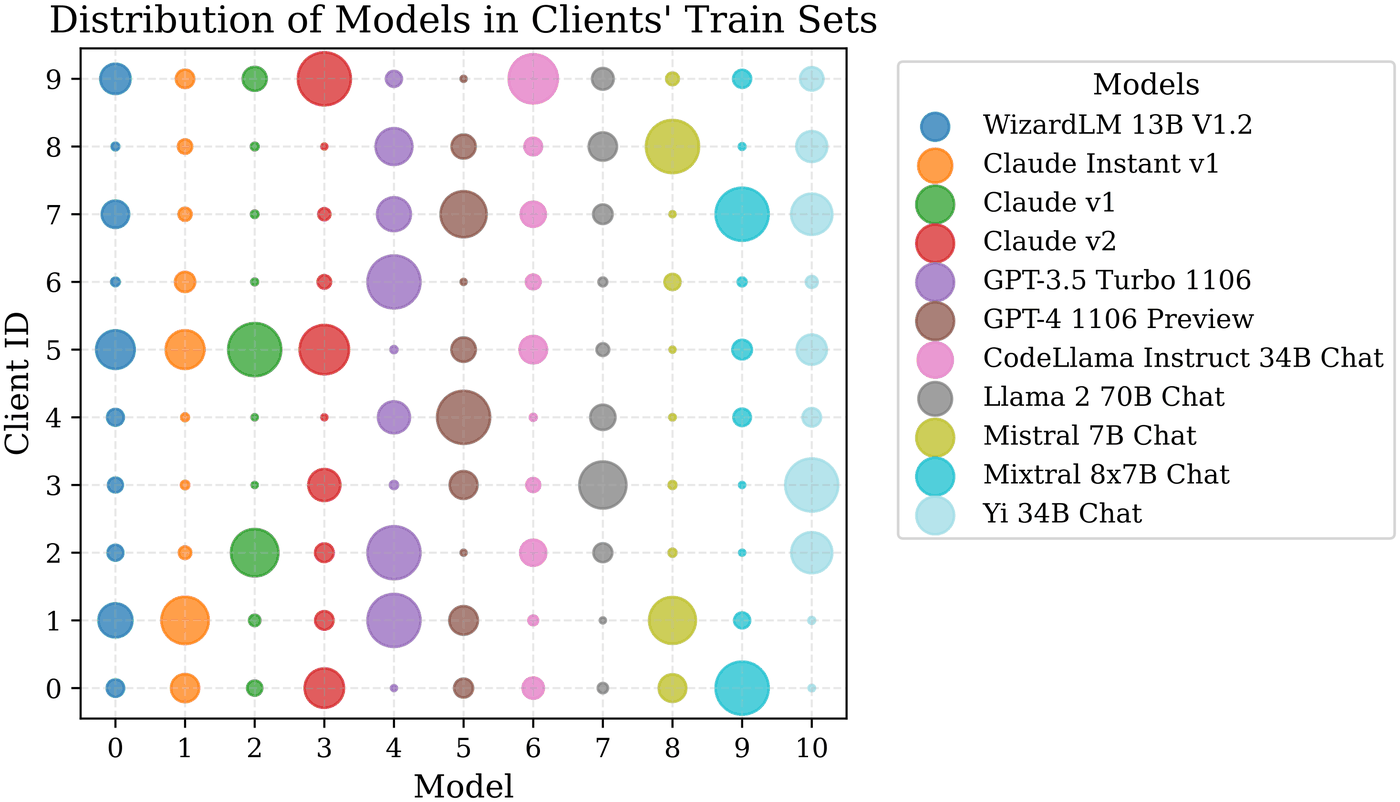
The widget below uses the client partitions and evaluation counts from the experiments. Selecting a client shows the distribution of its queries, how its task mixture differs from the pooled distribution, and which models have observed evaluations. The pooled view shows the aggregate information available to federated training. Across clients, the query distributions overlap substantially, whereas model coverage remains sparse and imbalanced.
The two sliders regenerate the partition. They expose both Dirichlet concentration parameters: the concentration over task labels, which controls how unevenly queries are partitioned across clients, and the concentration over the model pool, which controls how narrow each client’s logging distribution becomes. Reducing the first to the $\alpha = 0.03$ used in the extreme-heterogeneity study transforms moderate distributional skew into nearly disjoint client distributions, leaving some clients with very few samples.
Interactive · what one client can see
Query space
Drag to rotate · click, then scroll to zoom · double-click to reset
Bar: this selection. Tick: the pooled share of the same task.
Evaluations available per model
- Training queries
- —
- Query-space footprint
- —
- Models with evaluations
- —
- Thinnest model cell
- —
Loading the client partition…
In the configuration used throughout the paper, ten clients collectively hold 27,368 training queries, and the largest holds 4.6 times as many as the smallest. The contrast between the two panels is central to the setting. In query space, the clients overlap: each covers roughly half of the occupied embedding space on average. In model coverage, however, they differ substantially. Nine of the 110 client-model pairs contain no evaluations whatsoever, and another fourteen contain fifteen or fewer, providing insufficient data for reliable accuracy and cost estimation. Claude v1 illustrates the imbalance: it is the most-evaluated model overall, with 4,727 records, yet those records are distributed across only five of the ten clients, and a single client accounts for 2,832 of them. Pooled across clients every model has at least 1,416 evaluations and all fifteen task groups are present.
These statistics indicate that the primary limitation of a client-local router is not coverage of its own query distribution, but evidence about models that the client rarely invokes.
The routing objective
Given a pool of models $\mathcal{M}$ and a query embedded as $\mathbf{x}$, write $\text{acc}(\mathbf{x}, m)$ for the expected quality of model $m$’s response and $\text{cost}(\mathbf{x}, m)$ for its expected inference cost. The router maximizes a Lagrangian combination of the two:
\[U_{\lambda}(\mathbf{x}, m) \;=\; \text{acc}(\mathbf{x}, m) \;-\; \lambda \cdot \text{cost}(\mathbf{x}, m)\]Smaller $\lambda$ prioritizes accuracy, whereas larger $\lambda$ favors lower-cost models; sweeping $\lambda$ traces the accuracy-cost frontiers reported in the experiments.
Neither quantity is known before the model has answered, so the router learns estimators $\mathsf{A}(\mathbf{x}, m) \approx \text{acc}(\mathbf{x}, m)$ and $\mathsf{C}(\mathbf{x}, m) \approx \text{cost}(\mathbf{x}, m)$ and then routes greedily:
\[\pi_{\lambda}(\mathbf{x}) \;=\; \arg\max_{m \in \mathcal{M}} \big[\, \mathsf{A}(\mathbf{x}, m) - \lambda\, \mathsf{C}(\mathbf{x}, m) \,\big]\]Estimating accuracy and cost rather than directly classifying the best model is particularly useful in the federated setting. Clients may have different cost-quality preferences, and because $\lambda$ enters only at inference time, each can choose its own operating point on the frontier without retraining the router.
A client $i$ holds a dataset of tuples
\[\mathcal{D}_i \;=\; \big\{ (\mathbf{x}_i^{(j)},\, m_i^{(j)},\, \widehat{\text{acc}}_i^{(j)},\, \widehat{\text{cost}}_i^{(j)}) \big\}_{j=1}^{D_i}\]where $m_i^{(j)}$ is the one model that query $j$ was actually evaluated on. The union over clients is $\mathcal{D}$, with $D = \sum_i D_i$ records in total.
Federated MLP-Router
The parametric router is a shared trunk $h_{\theta}$ mapping a query embedding to a hidden representation, followed by one linear head per model producing that model’s accuracy and cost estimates. The shared trunk allows an evaluation of one model to inform predictions about the others, which is precisely the form of cross-model transfer that is valuable when each record contains feedback for only one model.
Training minimizes squared error over the observed cells only:
\[\mathcal{L}(\theta) \;=\; \frac{1}{|\mathcal{D}|} \sum_{i=1}^{N} \sum_{j=1}^{|\mathcal{D}_i|} \Big[ \ell\big(\widehat{\text{acc}}_i^{(j)},\, \mathsf{A}_{\theta}(\mathbf{x}_i^{(j)}, m_i^{(j)})\big) \;+\; \ell\big(\widehat{\text{cost}}_i^{(j)},\, \mathsf{C}_{\theta}(\mathbf{x}_i^{(j)}, m_i^{(j)})\big) \Big]\]This objective decomposes into per-client terms and can therefore be optimized with FedAvg. In each round, the server broadcasts the current weights to a participating subset of clients; each client runs several local steps on its private data; the server averages the returned parameters using weights proportional to client dataset size. Raw queries remain local, and because the cost of a round is set by the size of the router rather than by the size of the evaluation logs, communication remains compact.
The trunk-head decomposition provides a natural mechanism for sparse supervision. Every record a client holds updates the trunk, but it updates only the head of the model on which it was actually evaluated, so heads corresponding to unobserved models remain unchanged locally. Since the trunk carries almost all of the parameters, most of what each client learns is shared, while model-specific heads receive updates during aggregation from clients that observed the corresponding models.
Federated K-Means-Router
The nonparametric router does not train a predictive model. Instead, it partitions the embedding space into regions and treats accuracy and cost as approximately constant within each region, so the estimator for a new query is the empirical average over the region it falls into. This design is naturally incremental: incorporating a new model requires new cluster-level averages rather than retraining the full router.
The federated algorithm aggregates both the embedding-space partition and the associated evaluation statistics in two passes.
Pass one: constructing global regions
Each client runs $K$-means over its own query embeddings and sends the server its cluster centroids together with the number of points in each. The server then runs a weighted $K$-means over the pooled centroids, each centroid weighted by its cluster size, so the global centers minimize a size-weighted squared-distance objective over the local summaries. The resulting $K_{\text{global}}$ centers are broadcast back. Only centroids and counts are transmitted; no query leaves its client.
Pass two: aggregating evaluation statistics
Each client assigns its own samples to the global centers and, for every (cluster, model) pair it has data for, computes the mean observed accuracy and cost along with the corresponding sample count. Pairs with no samples are not reported, allowing the aggregation procedure to handle sparse observations explicitly. The server aggregates the reported means into a global estimate weighted by the sample counts:
\[\mathsf{A}_k^{(m)} \;=\; \frac{\sum_i n_{i,k}^{(m)}\, \bar{a}_{i,k}^{(m)}}{\sum_i n_{i,k}^{(m)}}\]with the cost statistics aggregated the same way. At inference a query is mapped to its nearest global center and routed using that cell’s accuracy and cost table.
Aggregation increases the effective sample size of sparse (cluster, model) cells. A cell that is empty or nearly empty on any single client can receive substantially more samples once the counts from all clients are summed; these per-cell counts directly control the estimation error.
The walkthrough below executes both passes on the experimental client partition; the centroids, weights, and resulting coverage are computed interactively.
Interactive · how the federated K-Means router is built
Drag to rotate · click, then scroll to zoom · double-click to reset
client queries local centroids global centroids
Loading the client partition…
The clustering runs live on a proportional subsample of the real client partition, projected to three dimensions with t-SNE over the same all-mpnet-base-v2 encodings the paper uses. The deployed router clusters in the full 768-dimensional space, where distances differ, so read this as the shape of the procedure rather than the exact partition it produces. Paper settings are 15 clusters per client and 20 at the server.
Theoretical benefits of collaboration
Two theoretical results characterize the benefits of federated collaboration.
For the parametric router, federated averaging on this objective converges at the standard nonconvex FedAvg rate under bounded heterogeneity, unbiased gradients and smoothness. With $N$ clients, $\tau$ local steps and $T$ rounds, the smallest expected squared gradient norm along the trajectory is bounded by $\widetilde{\mathcal{O}}\big((1 + A\sigma^2)/\sqrt{N \tau T}\big)$, where $\sigma^2$ bounds the mini-batch gradient heterogeneity and $A = N \sum_i (D_i/D)^2$ measures how unevenly the data is distributed. When clients hold equal shares, the result yields the standard linear speedup in the number of clients.
The second result concerns the routing policy rather than the optimization. Define the suboptimality of a policy $\widehat{\pi}$ against the best possible policy $\pi^{\star}$ on a test distribution as
\[\text{Subopt}(\widehat{\pi}) \;=\; \mathbb{E}_{\mathbf{x}} \big[\, U_{\lambda}(\mathbf{x}, \pi^{\star}(\mathbf{x})) - U_{\lambda}(\mathbf{x}, \widehat{\pi}(\mathbf{x})) \,\big]\]For the parametric router, the bound for a client-local estimator scales approximately as $\widetilde{\mathcal{O}}(1/\sqrt{D_i})$, while the federated router, optimizing over the union, incurs $\widetilde{\mathcal{O}}(1/\sqrt{D})$. Since $D = \sum_i D_i$, the federated bound can therefore be tighter, particularly for clients that hold limited local data and when pooling improves coverage of the test distribution.
For the clustering router the bound decomposes into three interpretable terms: the average distance from a query to its assigned center, a term measuring the mismatch between training and test distributions across clusters, and a statistical term scaling as $1/\sqrt{n_{\min}}$, where $n_{\min}$ is the minimum sample count across any (cluster, model) estimate. Federated aggregation can reduce the first term because the global centers are fitted to the pooled query distribution, and can improve the third directly when summing counts across clients increases the minimum cell count.
Experimental setup
Experiments use RouterBench, which provides evaluations of 11 language models across 8 public datasets, giving 36,497 queries after preprocessing. Queries are embedded with the all-mpnet-base-v2 sentence encoder; two additional encoders are evaluated in the appendix without significant differences in centralized performance. The appendix repeats the full study on ProxRouter-Data, covering 14 models over 10 datasets.
The federated system simulates $N = 10$ clients with a participation rate of 0.6 in each round. Two separate sources of heterogeneity are induced:
- Query heterogeneity. Queries are partitioned across clients by a Dirichlet distribution with concentration $\alpha = 0.6$ over task labels, so each client’s prompt distribution is concentrated on a subset of tasks.
- Model heterogeneity. For each client a distribution over the 11 models is drawn from a Dirichlet with $\alpha = 0.45$, and each of that client’s queries is logged against a single model sampled from this distribution. This produces the uneven and partially missing coverage shown above.
Each client splits its data 75/25 into local train and test; the global train and test sets are the unions of those splits. Accuracy-cost curves are obtained by sweeping $\lambda$ over one hundred logarithmically spaced values from $10^{-2}$ to $10^{7}$, and each curve is summarized by its normalized area under the curve, with higher values indicating a better frontier.
The parametric router uses a two-layer trunk of width 512 with LayerNorm, GELU and dropout 0.1, and per-model heads predicting an accuracy logit and a normalized cost. It is trained with FedAvg using AdamW at learning rate $10^{-3}$, weight decay $3 \times 10^{-4}$, one local epoch per round, batch size 128 and gradient clipping at norm 1.0. The clustering router uses $K_{\text{local}} = 15$ clusters per client and $K_{\text{global}} = 20$ at the server, with Euclidean distance, three restarts and at most thirty Lloyd iterations, run as a single federated clustering stage.
The primary comparison is against client-local routers: the same router family trained independently by each client on its local data, without collaboration.
Results
Generalizing to the global query distribution
We first evaluate whether client-local routers generalize to queries beyond their local distributions. Each client-local router and the federated router are evaluated on the global test set.
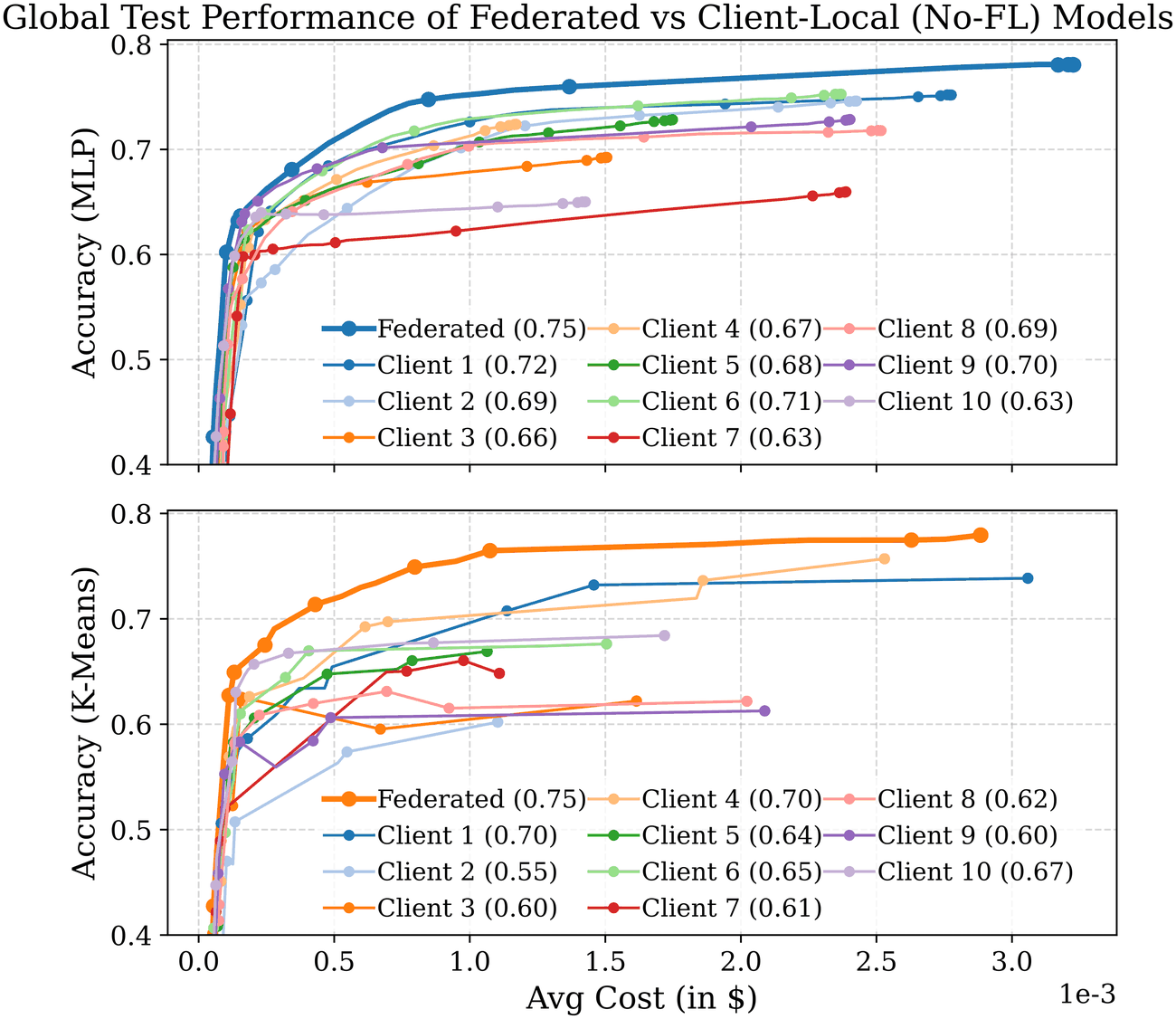
The federated parametric router reaches 0.75 normalized AUC against 0.63 to 0.72 for the ten client-local routers. The clustering router shows the larger gap: 0.75 federated against a client-local range of 0.55 to 0.70. These results are consistent with the theoretical benefits of pooling query coverage and per-model supervision across clients. Clustering quality degrades sharply when centers are fitted to a small, skewed sample, and a client-local clustering router consequently has both less representative partitions and sparse per-cell statistics. The federated method instead constructs global regions before aggregating the statistics.
Improved routing on client-local distributions
An additional question is whether collaboration improves performance on the distribution a client serves. Because the federated router is fitted across all clients, aggregation could reduce specialization to an individual client. However, evaluation on each client’s local test set shows consistent improvements in this setting.
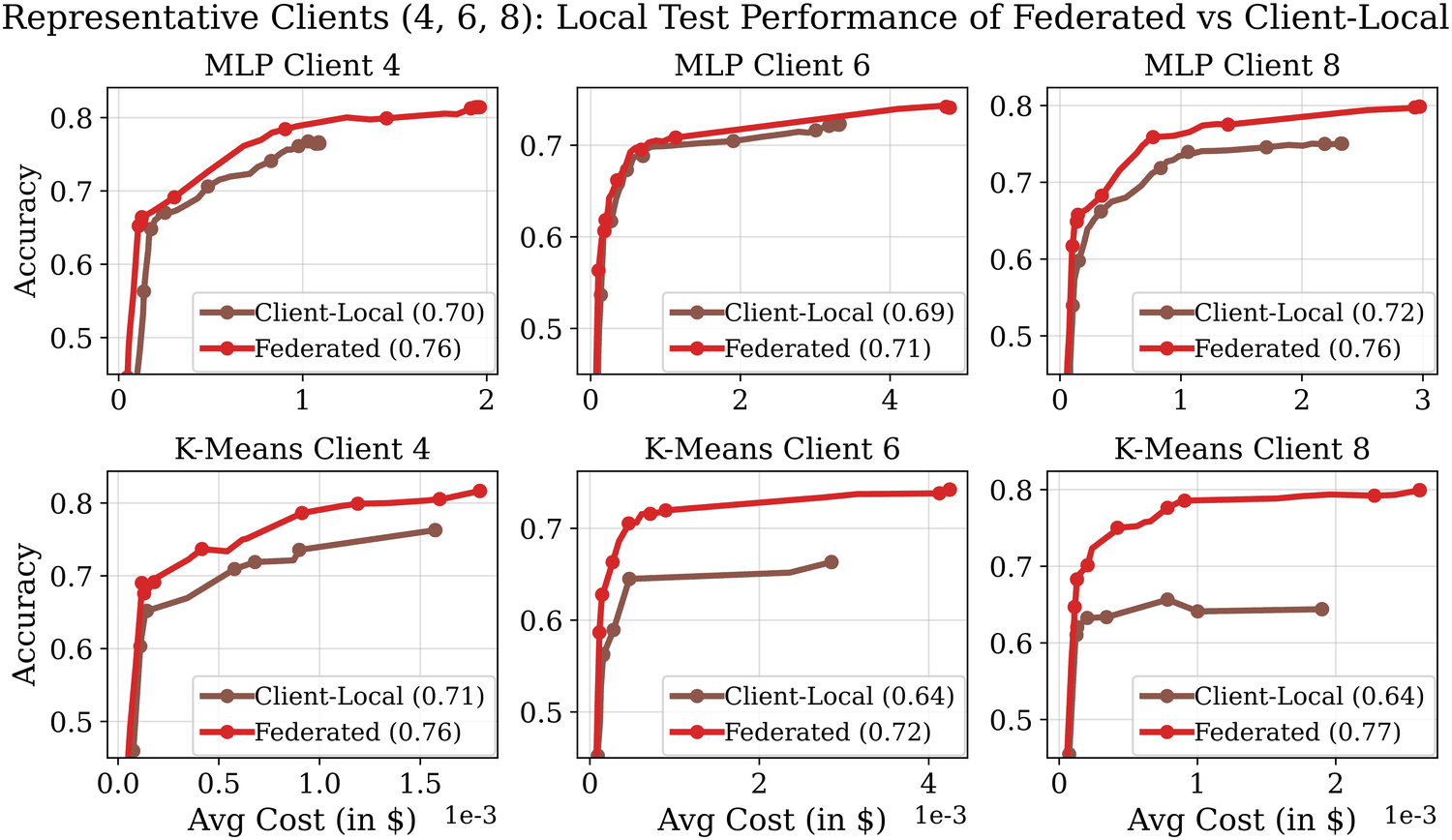
For the parametric router, clients 4, 6 and 8 improve from 0.70, 0.69 and 0.72 to 0.76, 0.71 and 0.76. For the clustering router the same clients improve from 0.71, 0.64 and 0.64 to 0.76, 0.72 and 0.77. The federated router attains higher AUC on all ten clients for both families.
The improvement is primarily attributable to model coverage rather than query coverage. For its local queries, a client already observes the relevant query distribution, but may lack reliable estimates of how rarely invoked models would perform. Federation provides supervision for these models through other clients, improving the relative model comparisons required for routing.
Comparison with centralized training
To quantify the performance cost of decentralization, we compare against a router trained directly on the pooled data.
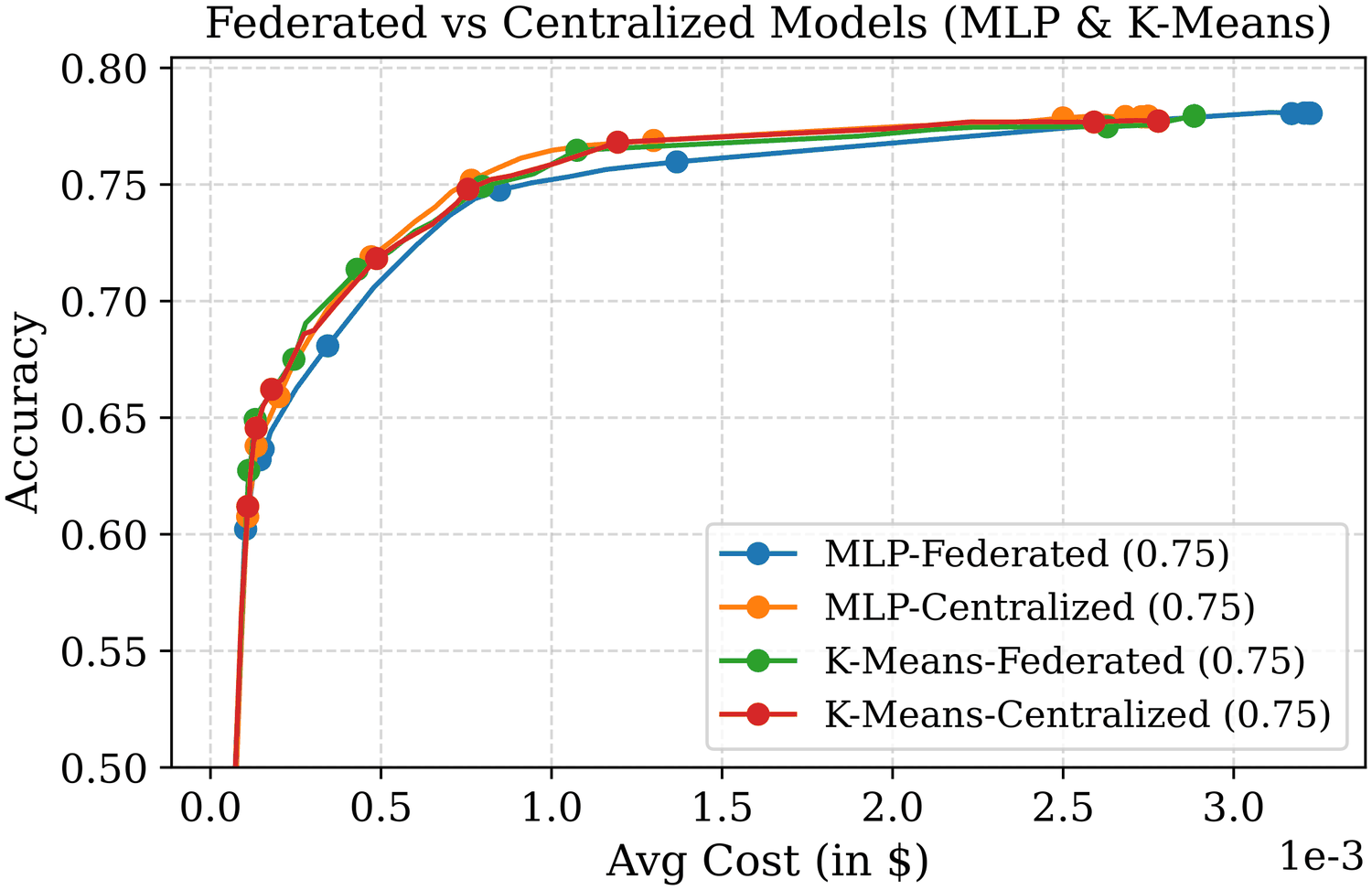
All four configurations achieve a normalized AUC of 0.75, indicating that federated optimization closely matches centralized training in this experimental setting.
Adding models to the pool
Model pools evolve over time, making full retraining for every newly available model costly. Three models are withheld during initial training and subsequently introduced, with each client evaluating them on a small calibration subset of about 10% of its prompts. The parametric router appends a head per new model and trains only that head, leaving the trunk and existing heads frozen. The clustering router requires no parametric training: the embedding space is unchanged, so only the per-cell statistics for the new models are required.
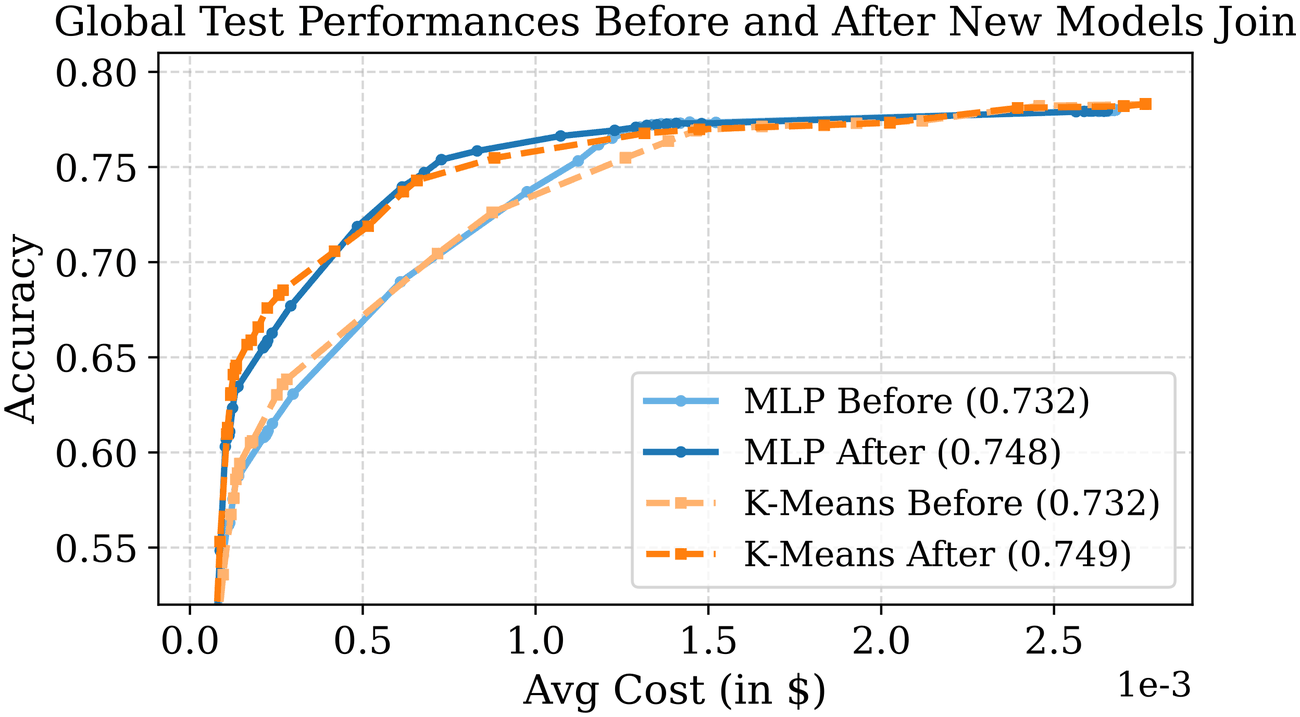
Without full retraining, normalized AUC increases from 0.732 to 0.748 for the parametric router and to 0.749 for the clustering router.
Adding clients to the system
New clients may also join after deployment. A suitable adaptation mechanism should incorporate their data, preserve performance for previously observed clients, and not require the existing clients to participate again. Training starts with 7 clients, after which 3 new ones join with data covering 30% of the task labels in the system.
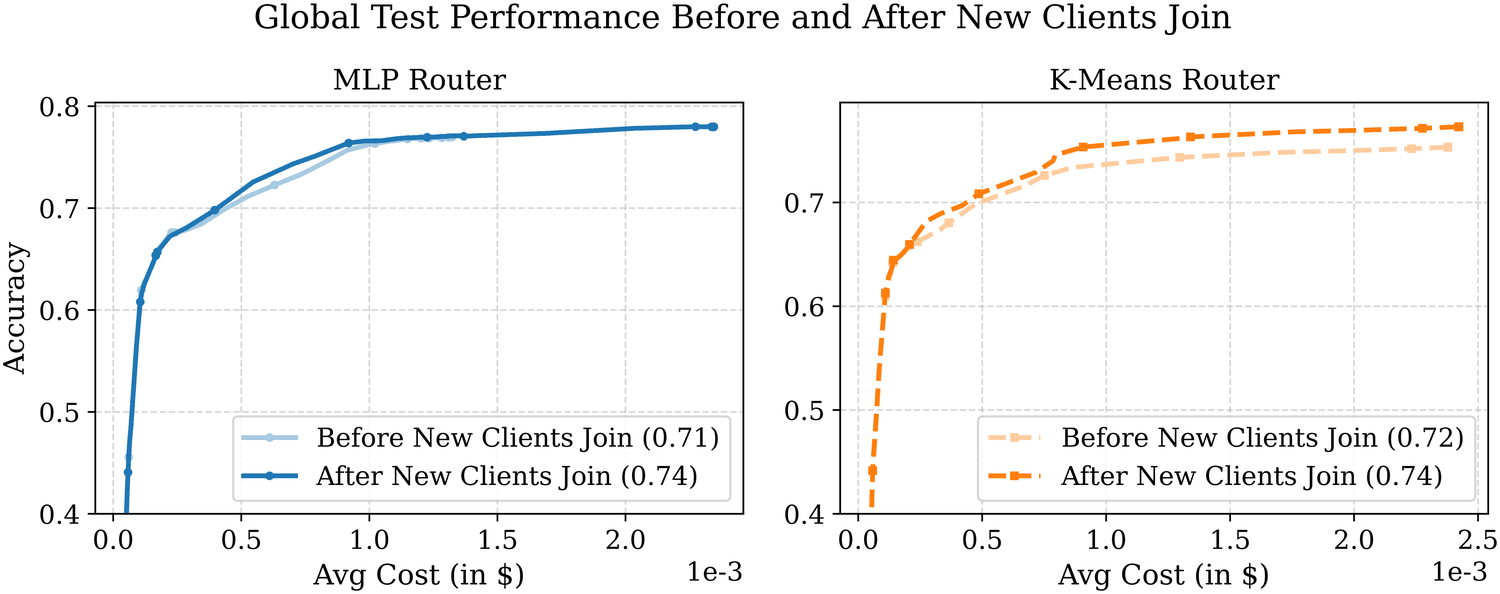
The parametric router improves from 0.71 to 0.74 and the clustering router from 0.72 to 0.74. The parametric method uses the distillation term to preserve the original policy while training only on new clients; the clustering router preserves prior information naturally, because incorporating a new client amounts to updating a weighted average.
Extreme heterogeneity and adaptive personalization
The preceding results use $\alpha = 0.6$, corresponding to moderate heterogeneity. Reducing the Dirichlet concentration to $\alpha = 0.03$ produces nearly single-task clients. In this regime, the global router may be mismatched to a particular client: if one client observes almost only biology prompts while the others rarely observe this domain, a globally fitted policy may underperform a specialized local router.
The proposed remedy is a per-client, per-model mixture of the federated and local estimators. Each client measures the mean absolute calibration error of both estimators on its own training points, requiring no additional model calls, and weights them inversely to their errors, separately for accuracy and cost.
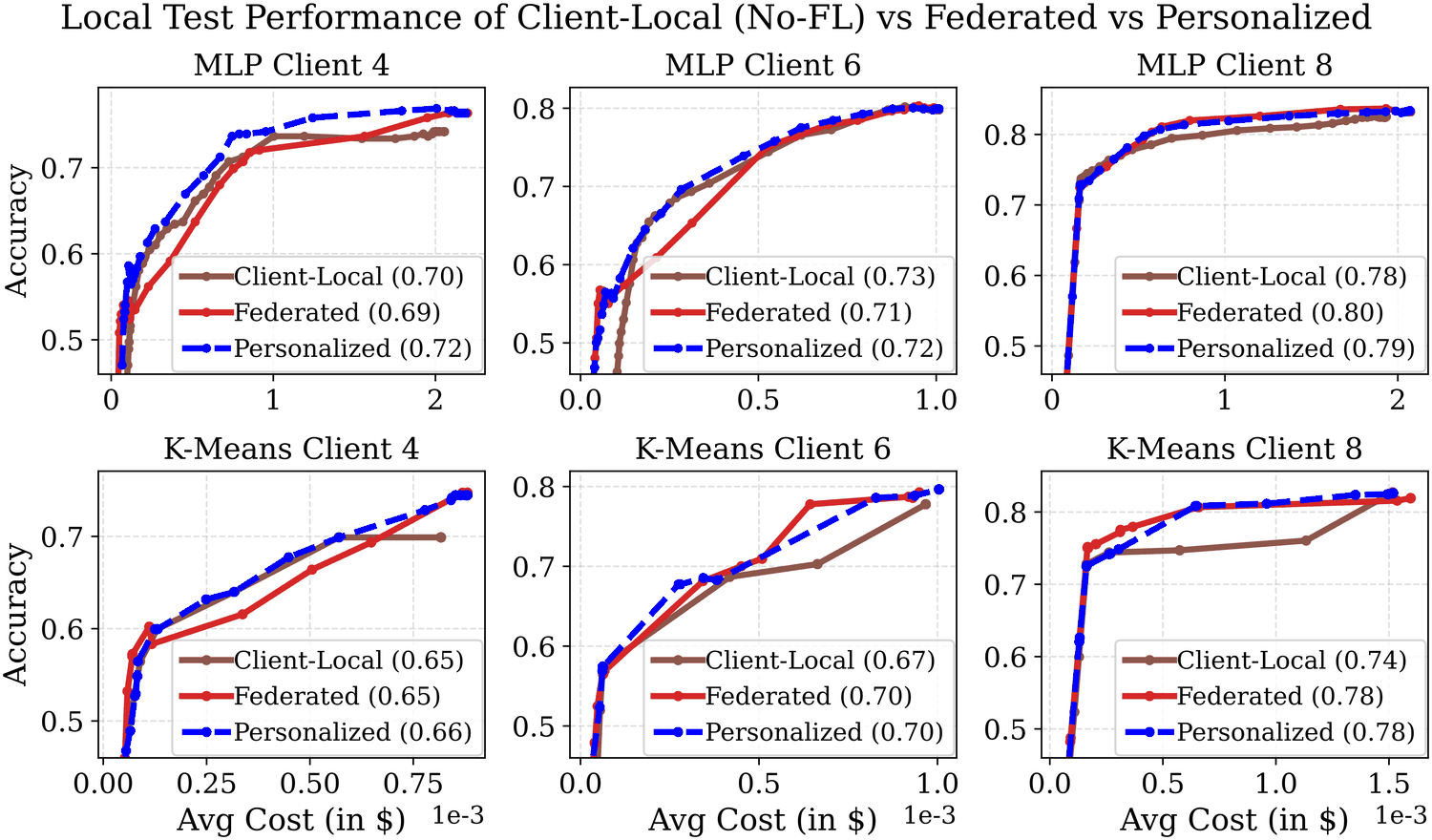
Under this regime, the federated parametric router underperforms client-local training on some clients: on clients 4 and 6 it reaches 0.69 and 0.71 against local scores of 0.70 and 0.73. The mixture mitigates this degradation, reaching 0.72 on both. On client 8, where the federated router already performs better at 0.80, the mixture achieves 0.79. The clustering router does not exhibit this degradation in the evaluated setting. Its local variant is more strongly limited by sparse per-centroid coverage than it benefits from specialization.
Summary
Most query-routing methods assume that training data can be centralized. Relaxing this assumption changes the problem: evaluation data are distributed across clients, each client sees a narrow slice of the query space, and because evaluation is expensive, each query contains feedback from only one model selected non-uniformly. This work provides federated training for both standard router families under those conditions, with a convergence guarantee for the parametric router and suboptimality bounds for both that characterize the benefit of pooling supervision across clients.
A central empirical finding is that federated training improves not only performance on the global distribution but also performance on each client’s own queries. In this setting, a client’s primary limitation is incomplete model coverage rather than insufficient knowledge of its local query distribution. Cross-client aggregation supplies the missing model supervision while keeping raw queries local.
Cite this work
@inproceedings{askin2026federate,
  title     = {Federate the Router: Learning Language Model Routers
               with Sparse and Decentralized Evaluations},
  author    = {Askin, Baris and Patel, Shivam and Nayak, Anupam and
               Vigano, Andrea and Woo, Jiin and Joshi, Gauri and
               Joe-Wong, Carlee},
  booktitle = {Advances in Neural Information Processing Systems},
  year      = {2026},
  url       = {https://arxiv.org/abs/2601.22318}
}