Publications ProxRouter
ProxRouter: Proximity-Weighted LLM Query Routing for Improved Robustness to Outliers
1Carnegie Mellon University 2Microsoft† Corresponding author
Routing queries to a model
State-of-the-art language models can contain billions or even trillions of parameters, making inference computationally expensive. Yet invoking a frontier-scale model for every query is often unnecessary: smaller, less expensive models can match the quality of larger models on many inputs, while specialized models may outperform general-purpose LLMs on particular domains at substantially lower cost. Query routing exploits this heterogeneity by selecting, for each incoming query, the model that best balances response quality and inference cost.
The plot below summarizes the model pool used in our experiments: 14 models evaluated across 10 datasets. Models are ordered by average accuracy and tasks by difficulty, producing an overall increase from left to right. Green denotes higher accuracy, red denotes lower accuracy, and white corresponds to 50%.
Interactive · drag to rotate, scroll to zoom
Loading…
Llama-3.3-70B is the strongest model overall, with 78.4% average accuracy, yet Deepseek-math-7B, with less than one-tenth as many parameters, achieves 77.1% on GSM8k compared with 40.8% for Llama-3.3-70B. Conversely, Deepseek-math-7B achieves 24.2% on MedQA, where Llama-3.3-70B reaches 84.7%. Because no single model dominates across all tasks, an effective router can improve both cost and accuracy relative to always invoking the largest model.
What the router has to estimate
The routing objective is to maximize accuracy subject to an inference-cost constraint. We use a Lagrangian relaxation, yielding the following unconstrained objective for each query:
\[m^{*}(\mathbf{x}) \;\leftarrow\; \arg\max_{m \in \mathcal{M}}\;\big[\,\text{acc}^{(m)}(\mathbf{x}) - \lambda \cdot \text{cost}^{(m)}(\mathbf{x})\,\big]\]Here $\mathbf{x}$ denotes the query embedding, while $\lambda$ controls the relative importance of accuracy and cost. Sweeping $\lambda$ traces the accuracy-cost trade-off reported throughout the experiments below.
Neither accuracy nor cost is known before inference, and both can vary across sampled responses: repeated generations for the same query may differ in correctness and output length. We write $U^{(m)}(\mathbf{x}) = \overline{U}^{(m)}(\mathbf{x}) + \epsilon^{(m)}(\mathbf{x})$, where $\overline{U}$ is the expected objective value and $\epsilon$ denotes zero-mean noise. Since this stochastic component is difficult to estimate directly, routing reduces to estimating $\overline{U}^{(m)}(\mathbf{x})$ for each model:
\[m^{*}(\mathbf{x}) \;\leftarrow\; \arg\max_{m\in\mathcal{M}} \widehat{U}^{(m)}(\mathbf{x})\]A distribution mismatch between the reference queries and test queries can therefore degrade estimates of $\widehat{U}^{(m)}(\mathbf{x})$ and, consequently, lead to suboptimal routing decisions.
Why nonparametric routers
Parametric routers train an auxiliary model to predict quantities such as correctness or inference cost. Nonparametric routers instead operate directly in the query embedding space and require no additional predictor training. Two common formulations are clustering-based approaches such as $K$Means and nearest-neighbor methods such as $k$NN.
Despite their simplicity, nonparametric routers can be competitive with parametric alternatives. A key reason is that modern encoder representations often organize queries into semantically meaningful regions, making local information in the embedding space informative of model performance:
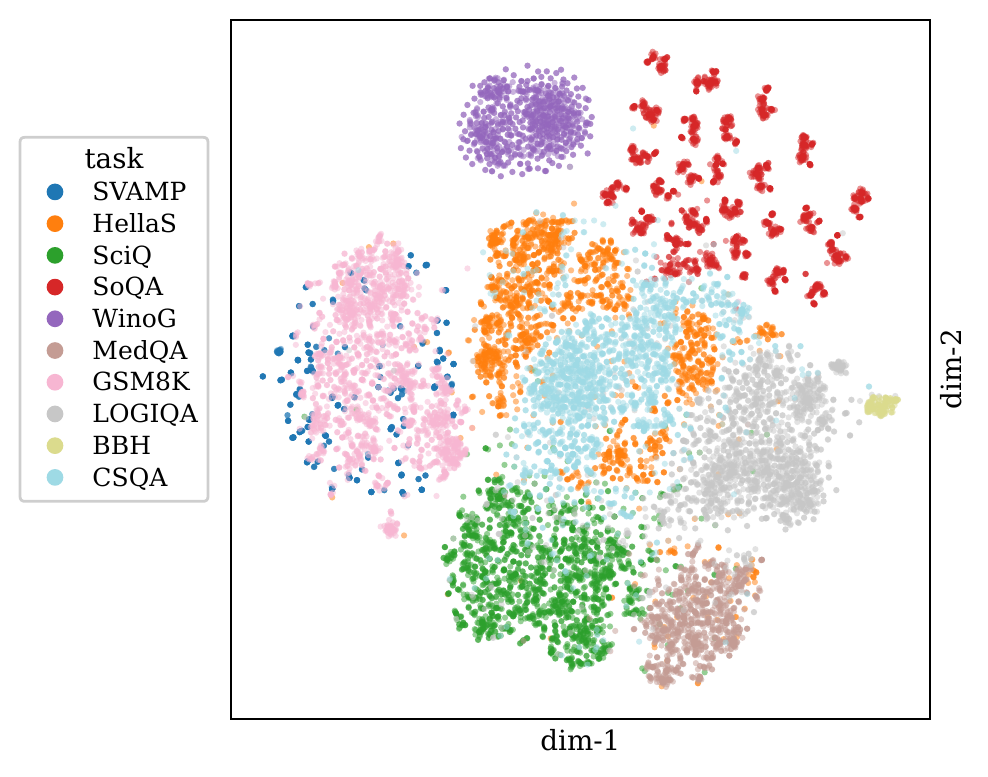
Clustering and nearest-neighbor methods can also incorporate new queries and models without retraining an auxiliary predictor, providing a practical advantage over parametric designs. We therefore focus on the nonparametric routing setting.
Where nonparametric routers fail
Accurate nonparametric estimates benefit from large and diverse reference sets in which queries have been evaluated on all, or most, models in the pool. Constructing such a set is expensive because it requires repeated inference across the model pool, so in practice routers are often built from a limited collection of downstream tasks. As new applications introduce previously unseen query types, this limited coverage can substantially degrade routing performance. Even seemingly modest distribution shifts, such as appending Chain-of-Thought instructions, can change both model accuracy and generation cost. Updating the router with such outlier queries requires evaluating them across the model pool, making frequent retraining expensive.
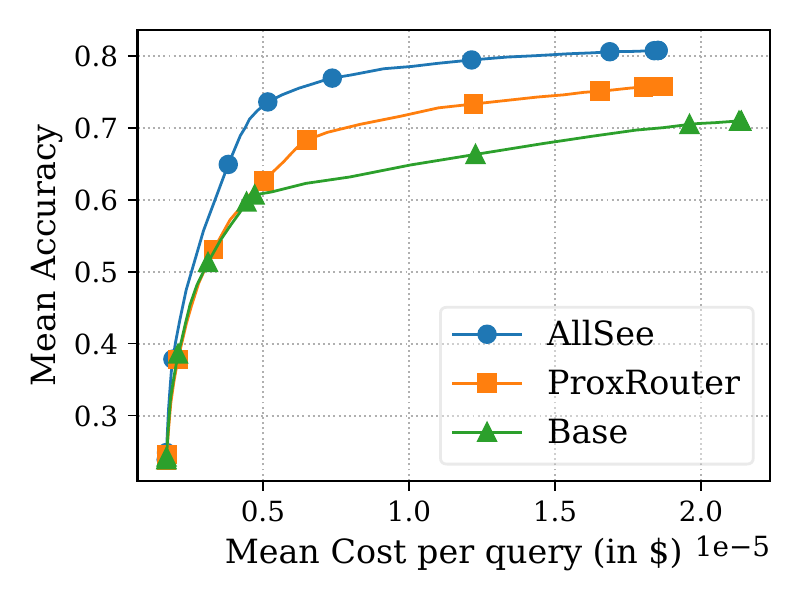
One approach is to explicitly detect outliers and route them using a separate mechanism. This introduces an additional prediction stage, however, whose errors and latency affect every query. ProxRouter instead applies the same soft aggregation rule to both inlier and outlier queries, eliminating the need for a separate outlier detector.
A unified view of nonparametric routers
Although $K$Means and $k$NN routers are usually presented as distinct algorithms, they can be expressed as instances of the same weighted estimator. Both operate on a reference set $\mathcal{I}$. Each element $i$ is associated with a reference vector $\mathbf{r}_i$ in the embedding space and an objective value $V_i^{(m)}$ for each model $m$.
For clustering routers, the reference elements are clusters: $\mathbf{r}_i$ is the centroid of cluster $c_i$, and $V_i^{(m)}$ is the average objective value across its training queries. For nearest-neighbor routers, each training query forms a reference element, with $\mathbf{r}_i$ equal to its embedding and $V_i^{(m)}$ equal to its observed objective value.
In both cases the estimate is a weighted average:
\[\widehat{U}^{(m)}(\mathbf{x}) \;=\; \sum_{i \in [\,|\mathcal{I}|\,]} w_i(\mathbf{x})\, V_i^{(m)}, \qquad w_i \ge 0,\;\; \sum_i w_i = 1\]Standard nonparametric routers correspond to particular choices of these weights. The $K$Means router assigns $w_i = 1$ to the cluster nearest to $\mathbf{x}$ and $0$ to all others. The $k$NN router assigns $w_i = 1/k$ to each of the $k$ nearest reference points and $0$ elsewhere.
Both weighting schemes discard potentially useful information. In $K$Means routing, hard nearest-cluster assignment creates discontinuous decision boundaries: small changes in a query can abruptly change the estimated objectives, particularly for outliers far from all centroids. The assignment also ignores intra-cluster dispersion, which is informative about the variance of $V_i^{(m)}$. In $k$NN routing, uniform weighting treats all selected neighbors equally, even when an outlier query is substantially closer to some neighbors than to others.
ProxRouter
ProxRouter replaces these fixed weighting rules with a query-dependent aggregation that is applied uniformly to inlier and outlier queries. It begins with minimum-variance priors $\mathbf{p}(\mathbf{x})$ over the reference set and then exponentially tilts them according to each reference element’s proximity to the query, producing bias-controlled weights $\mathbf{w}(\mathbf{x})$.
Step 1: minimum-variance priors
Reference elements can have different levels of uncertainty, quantified by $\text{Var}[V_i^{(m)}]$. The classical minimum-variance weighting is therefore $p_i(\mathbf{x}) \propto (\text{Var}[V_i^{(m)}])^{-1}$. For a cluster, this variance is determined by the variances of its $n_i$ constituent queries:
\[\text{Var}\big[V_i^{(m)}\big] \;=\; \frac{1}{n_i^{2}}\sum_{\mathbf{x}_\text{tr}\in c_i} \text{Var}\big[\epsilon^{(m)}(\mathbf{x}_\text{tr})\big]\]The exact per-query variance is unavailable in practice, so we approximate it using the geometry of the embedding space. More dispersed clusters tend to contain more semantically heterogeneous queries and are therefore treated as less reliable than compact clusters. Letting $s_i$ denote the mean distance from queries in a cluster to its centroid, we model variance as increasing with $s_i$ and decreasing with $n_i$, which yields the prior
\[p_i(\mathbf{x}) \;\propto\; n_i / s_i\]For $k$NN routers, reliable per-query variance estimates are not readily available, so we use the uniform prior $p_i(\mathbf{x}) = 1/k$ over the $k$ nearest reference elements.
Step 2: proximity-based tilting
The minimum-variance estimator can introduce substantial bias because it does not account for the proximity of each reference element to the test query. To reduce this bias, we reweight the priors using a proximity penalty $\phi_i(\mathbf{x})$ that increases with the distance $d(\mathbf{x}, \mathbf{r}_i)$:
\[w_i(\mathbf{x}) \;\propto\; p_i(\mathbf{x})\, \exp\!\big(-\phi_i(\mathbf{x})/\tau\big)\]These weights arise as the solution to a convex optimization problem that explicitly balances proximity-induced bias and estimator variance. The first term favors nearby reference elements, while the second regularizes the weights toward the low-variance prior:
\[\min_{\mathbf{w}\in\Delta^{|\mathcal{I}|}}\;\; \sum_i w_i(\mathbf{x})\,\phi_i(\mathbf{x}) \;+\; \tau\,D_{\text{KL}}\big(\mathbf{w}(\mathbf{x})\,\|\,\mathbf{p}(\mathbf{x})\big)\]Thus, $\tau$ provides a single parameter controlling the bias-variance trade-off. Increasing $\tau$ moves the weights toward the low-variance prior, whereas decreasing it places greater emphasis on proximity. The standard routers correspond to the two extremes: $\tau = 0$ gives the $K$Means router with closest-cluster assignment, while $\tau \to \infty$ with uniform priors gives the $k$NN router with uniform averaging.
Algorithm — ProxRouter
- $p_i(\mathbf{x}) \propto \big[\text{Var}(V_i^{(m)})\big]^{-1}$ least-variance priors
- $w_i(\mathbf{x}) \propto p_i(\mathbf{x})\exp(-\phi_i(\mathbf{x})/\tau)$ proximity tilting
- $\widehat{U}^{(m)}(\mathbf{x}) \leftarrow \sum_i w_i(\mathbf{x})\,V_i^{(m)}$ estimated objective
- $m^{\star}(\mathbf{x}) \leftarrow \arg\max_{m\in\mathcal{M}} \widehat{U}^{(m)}(\mathbf{x})$ chosen model
How the weights behave
The interactive example below illustrates four clusters of training queries in a stylized embedding space. Drag the query marker, or use the preset buttons, to compare how the base router and ProxRouter distribute aggregation weight. Because the clusters differ in both size and dispersion, the minimum-variance prior $n_i/s_i$ is non-uniform.
Interactive · how the aggregation weights are computed, shown for the KMeans router
For a query well inside a cluster, the two routers behave similarly, corresponding to the typical inlier setting. Their behavior differs more substantially between clusters. The base router assigns all weight to cluster B because its centroid is marginally closest. ProxRouter instead distributes mass across multiple clusters and assigns more weight to C than to B because C contains more samples and has lower dispersion, making its summary $V_i^{(m)}$ less noisy under the variance model. Near a cluster boundary, the base router can change assignments abruptly under small query perturbations, whereas ProxRouter’s weights vary smoothly.
The slider controls $\tau$. At the far right, ProxRouter reduces to the base router. At the far left, the weights approach the prior and become independent of the test query’s location.
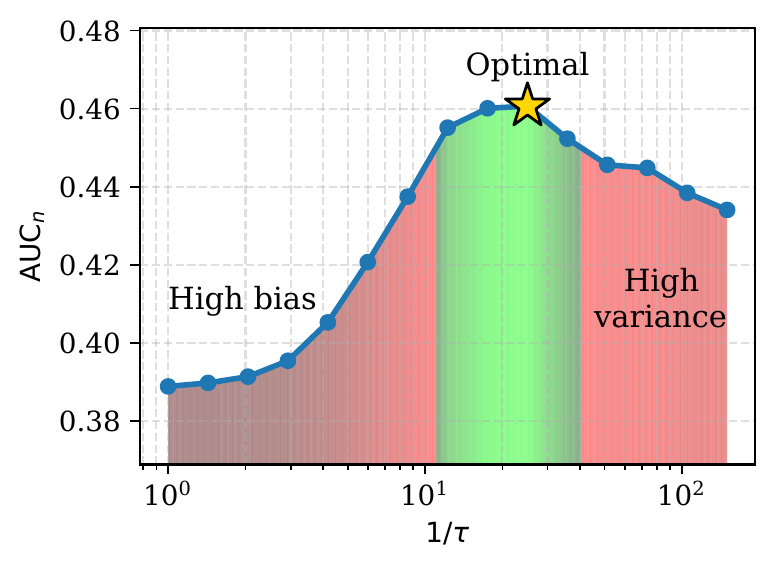
ProxRouter preserves the underlying clustering or nearest-neighbor routing structure. The only additional computation is the evaluation of the priors followed by the proximity-based reweighting.
Experimental setup
We evaluate ProxRouter on 10 publicly available query datasets using a pool of 14 LLMs spanning a broad range of parameter counts and capabilities. Queries are embedded with the MPNet-base sentence encoder, and proximity is measured using cosine distance. We consider two forms of under-representation in the router training set:
-
Leave-Task-Out, where the training set contains no queries from the outlier tasks. This creates a natural stress test for clustering routers, since no cluster is formed from the outlier distribution. We use this setting to evaluate $K$M-Prox.
-
Few-Shot-Outlier, where only a small number of queries from the outlier tasks are available in training (about 25). For nearest-neighbor routers, uniform averaging can dilute the contribution of these few relevant examples among a larger set of neighbors. We use this setting to evaluate $k$NN-Prox.
We compare three routers. Base denotes the standard nonparametric router. Prox applies ProxRouter using exactly the same training set. AllSee is trained with access to both inlier and outlier tasks and therefore serves as a full-information reference for routing performance.
Performance is summarized by the area under the mean accuracy-cost curve, normalized by the cost range and reported as a percentage ($\text{AUC}_n$). Higher values correspond to a better accuracy-cost trade-off: greater accuracy at a fixed cost, or lower cost at a fixed accuracy.
Results
Clustering routers
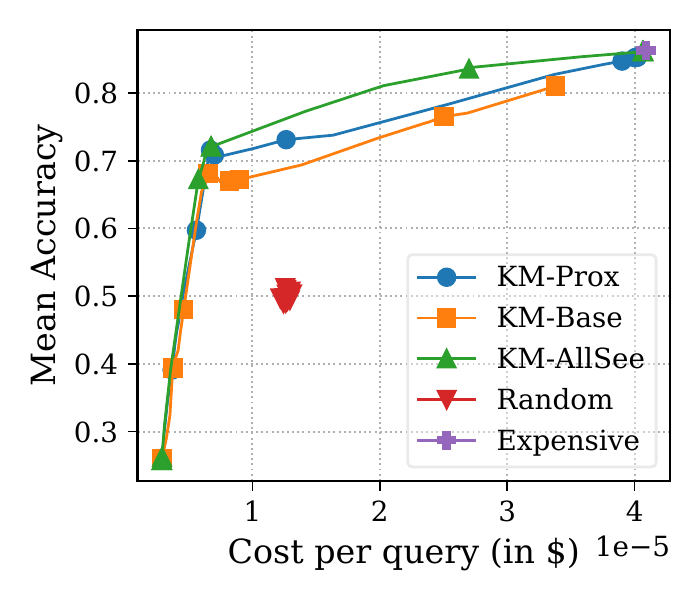
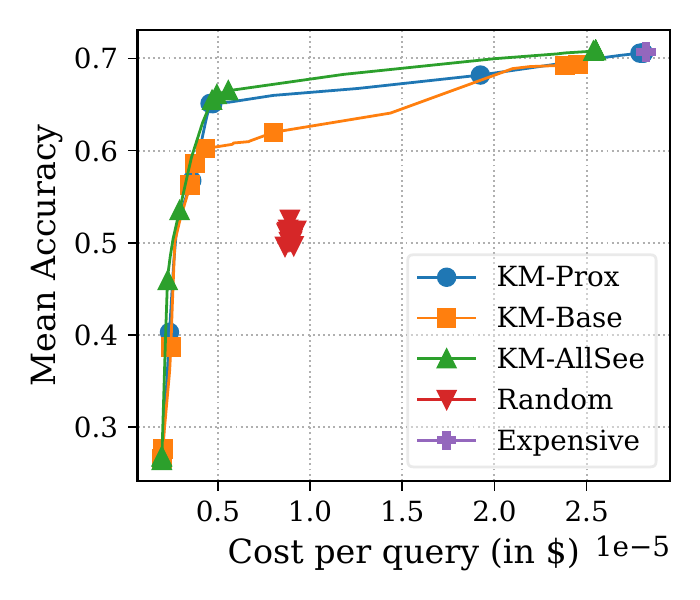
For $K$M-Base, $K$M-Prox, and $K$M-AllSee, we use $K = 32$, cosine distance as the proximity penalty, and $1/\tau = 20$.
| Outlier tasks | Split | $K$M-Base | $K$M-Prox | $K$M-AllSee |
|---|---|---|---|---|
| HellaSwag, MedQA | Outlier | 70.68% | 74.88% +4.20 | 78.36% |
| Inlier | 74.62% | 74.86% | 74.63% | |
| Overall | 73.04% | 75.12% | 74.87% | |
| LogiQA, CSQA, BBH | Outlier | 63.39% | 66.18% +2.79 | 67.25% |
| Inlier | 79.35% | 79.92% | 79.74% | |
| Overall | 71.61% | 73.46% | 73.88% |
For both outlier sets, $K$M-Prox improves normalized AUC relative to $K$M-Base while using the same training set and incurring negligible additional routing cost. It also closes a substantial portion of the gap to $K$M-AllSee. Performance on inlier tasks is nearly unchanged across the three routers, indicating that the improvement on unseen tasks does not come at the expense of inlier routing quality.
Nearest-neighbor routers
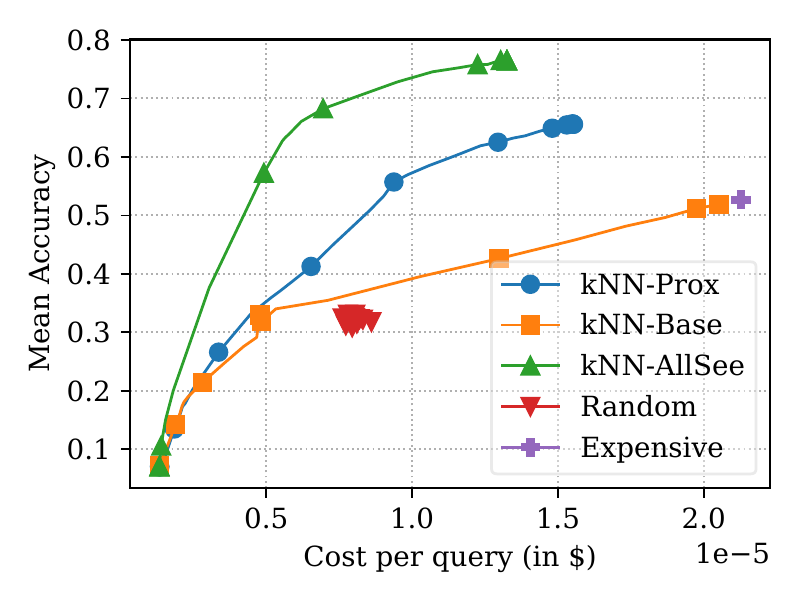
For $k$NN-Base, $k$NN-Prox, and $k$NN-AllSee, we use $k = 100$ and $1/\tau = 20$. The training set contains approximately 25 queries from the math tasks GSM8k and SVAMP.
| Outlier tasks | Split | $k$NN-Base | $k$NN-Prox | $k$NN-AllSee |
|---|---|---|---|---|
| GSM8k, SVAMP | Outlier | 38.55% | 46.64% +8.09 | 60.77% |
| Inlier | 77.51% | 76.96% | 79.11% | |
| Overall | 63.98% | 68.12% | 74.60% |
ProxRouter increases outlier $\text{AUC}_n$ by 8.1 points, from 38.5% to 46.6%. $k$NN-Prox also attains higher accuracy at substantially lower average cost than $k$NN-Base. The model pool contains specialized models that can outperform the largest general-purpose model on particular domains: on GSM8k, Deepseek-math-7B exceeds Llama-3.3-70B by 36 percentage points. Uniform averaging across 100 neighbors dilutes the influence of the few math examples available in the training set, causing $k$NN-Base to favor the more expensive general model. Proximity weighting increases the contribution of these relevant neighbors, enabling selection of the specialist.
Why some outliers hurt more than others
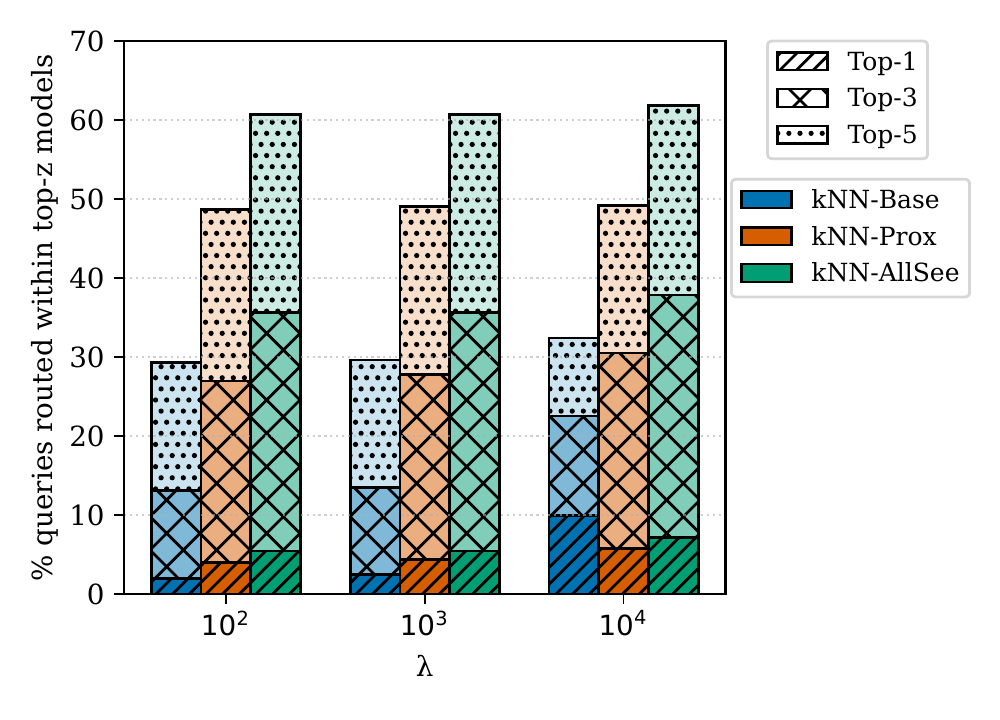
The performance gap between AllSee and Base depends strongly on the outlier task. When an outlier task favors models that are also effective on the inlier tasks, the router can partially transfer information from its existing reference set and the gap remains small. Outlier tasks with substantially different model preferences produce larger degradations.
To quantify this relationship, we compare model rankings between inlier and outlier tasks. For a task $t$ and value of $\lambda$, let $S_z(t,\lambda)$ denote the set of the top-$z$ models according to objective value. We define their top-$z$ Jaccard similarity as
\[J_z(t_\text{out}, t_\text{in}, \lambda) = \frac{|S_z(t_\text{out},\lambda) \cap S_z(t_\text{in},\lambda)|}{|S_z(t_\text{out},\lambda) \cup S_z(t_\text{in},\lambda)|}\]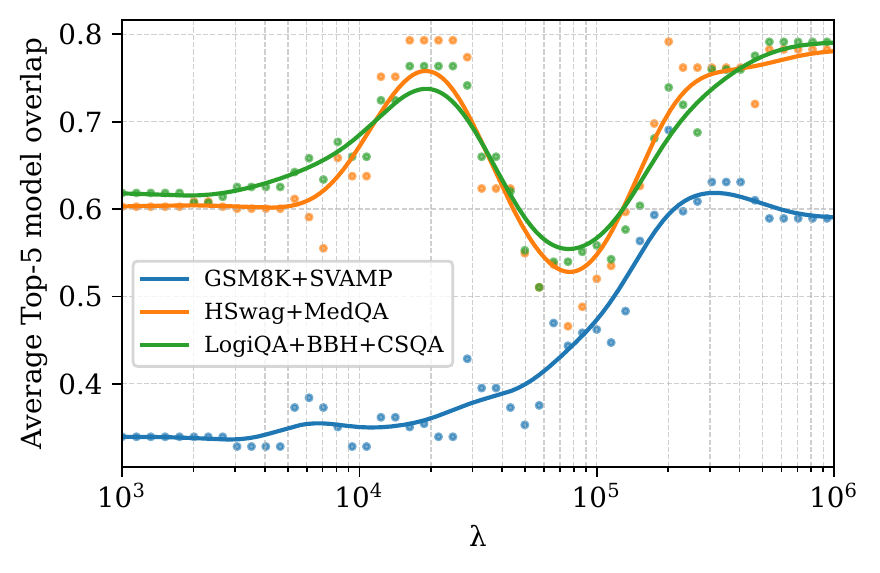
A low average $J_z^\lambda$ indicates that outlier and inlier tasks favor substantially different models, and is associated with a larger Base-AllSee performance gap. Higher values indicate greater agreement in model preferences and correspondingly smaller gaps. This analysis also provides a signal for when to retrain. Persistently low $J_z^\lambda$ for incoming queries indicates that the model preferences of the test distribution differ from those represented by the existing router. Retraining can be triggered when $J_z^\lambda$ falls below a threshold selected on validation data, balancing the cost of evaluating new queries across the model pool against the expected loss in routing performance. ProxRouter improves robustness between such retraining events.
Computational overhead
The additional computation consists of evaluating the prior and applying one exponential reweighting. We measure routing latency across varying training-set sizes, values of $k$, numbers of clusters, and embedding dimensions from 128 to 768. Across these settings, the additional latency remains in the millisecond range—roughly two orders of magnitude below the seconds-scale latency of autoregressive LLM generation. The storage requirement is similarly modest: 10,000 training-query embeddings at 768 dimensions in float32 occupy approximately 35 MB, and routing can be executed on a single CPU thread.
Summary
We study train-test mismatch in LLM query routing and introduce ProxRouter, a proximity-weighted framework for nonparametric routers that improves robustness to outlier queries while preserving inlier performance. The central idea is to prioritize reference queries that are close to the test query when estimating each model’s accuracy-cost objective. Exponential tilting provides a principled mechanism for controlling the resulting bias-variance trade-off with a single hyperparameter. We further formulate a broad family of nonparametric routers within a common weighted- aggregation view, providing a unified perspective for analysis and implementation. We also show how shifts in model rankings can inform retraining decisions. Although this work focuses on $k$NN and $K$Means routers, extending the framework to fuzzy, spectral, and kernel-based methods is a natural direction for future work.
Cite this work
@inproceedings{
  patel2026proxrouter,
  title     = {ProxRouter: Proximity-Weighted {LLM} Query Routing
               for Improved Robustness to Outliers},
  author    = {Shivam Patel and Neharika Jali and
               Ankur Mallick and Gauri Joshi},
  booktitle = {The 29th International Conference on Artificial
               Intelligence and Statistics},
  year      = {2026},
  url       = {https://openreview.net/forum?id=GYWls3tyqM}
}